
Quilt Coat making adventures and new art for my home
I have a very well developed skill of taking something simple and making it complex. Here I go again. I’m going to be taking a Quilt Coat class with my local guild, the Folsom Quilt and Fiber Guild. The instructor, Diane Karna, sent out directions for prep work before class. The idea was to take an old quilt and cut it up.
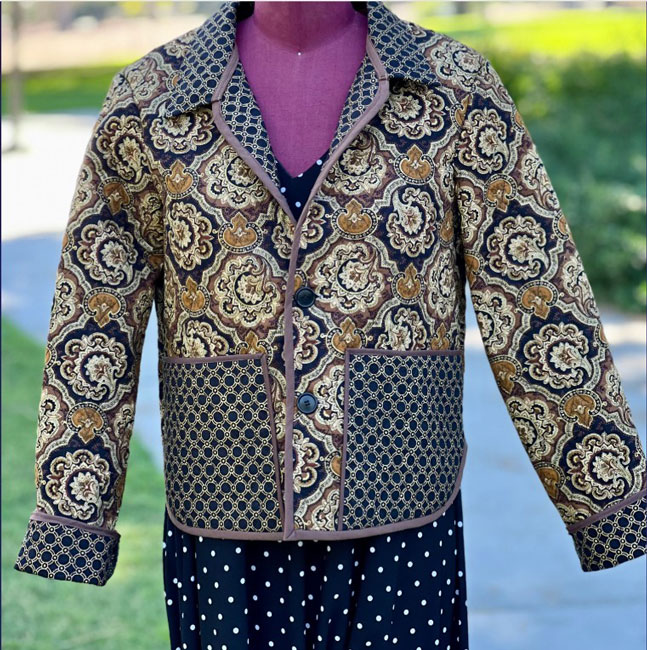
I grabbed this photo from Diane’s site, an example of the pattern we will be using.
I wrote about my process last week that led me to a beautiful piece of hand dyed silk that I had pre-quilted for some unknown reason. I thought that would save me some time. HAH! That just led me down a rabbit hole as I searched for companion fabrics.
I have a considerable silk stash. This week I chose a raw silk that I’ve had in my stash for over decade for the sleeves. Oy. So many problems:
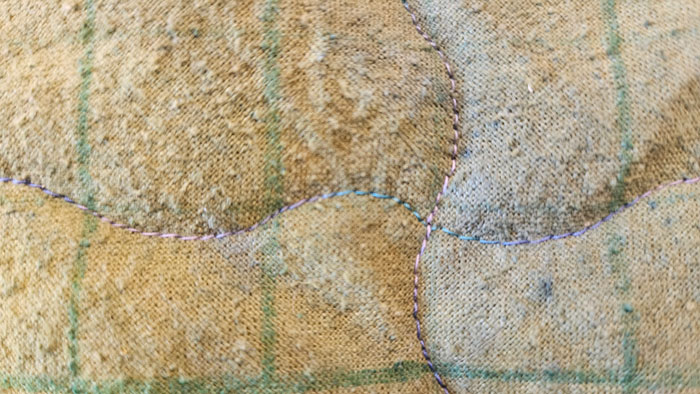
It has significant texture to it. That means that it absorbs light and it’s super hard to see markings on it. It also absorbed my markings and I had to mark twice – uhg! That is a total of 3 hours of marking. Can you see above that even though this is the re-marked piece and lines are more visible, yet you can barely see the marked horizontal line in the middle left of the photo? I actually had to imply the lay of the line in many cases as it would just disappear on a particularly splotchy part of the hand dye. This happened all over the piece. So frustrating. If you’ve even been my student, you’ve heard me say “If you can’t see it, you can’t quilt it”. True.
It didn’t help that I was having machine problems. I was soooo annoyed at my machine – it was shredding and skipping stitches like crazy. Everything was right – needle, thread, tension, presser foot pressure, path of the thread… But:
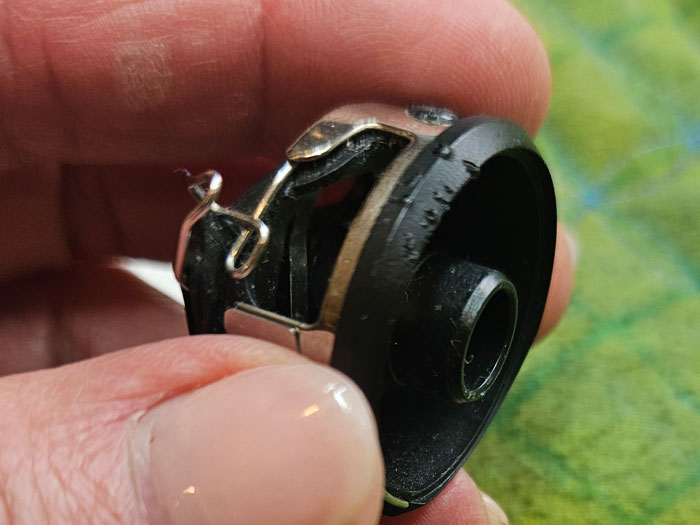
how on earth did I strike the bobbin case like that? I take meticulous care of my machine, keep it cleaned and serviced. I should have known it was Operator Error of some sort. Geez.
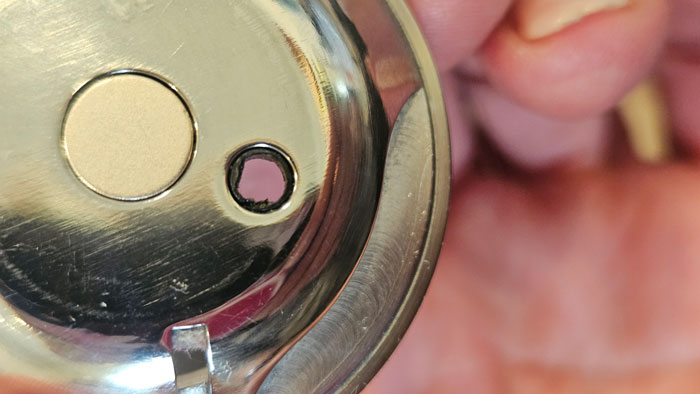
I’m not sure if this is even a functional issue; the tech who took it in did not know either. That hole is lined with a rubber gasket and the gasket was dinged up.
I learned something else. I knew that if you took your BERNINA to a non-certified tech for maintenance or repair, your warranty would be invalidated. But I didn’t know why. A BERNINA certified tech will use specialized proprietary equipment to service your machine. When your tech took their first training, they come home with a specialized kit of tools to service your machine. Lucky me, my local Meissner store has certified techs. But it’s going to be 2 weeks.
Of course I have a back up machine, er, machines! How could I ever live while waiting weeks for a repair?
My “class machine” that I tote to teach is a 535, a fully featured machine with a regular-sized throat and the big, fat new BERNINA bobbin that I can’t live without. It is the lowest end of the 5-series and I have to manually lift the presser foot (or use the lever) – woe is me! So I’m not exactly slumming it with my “back up”!
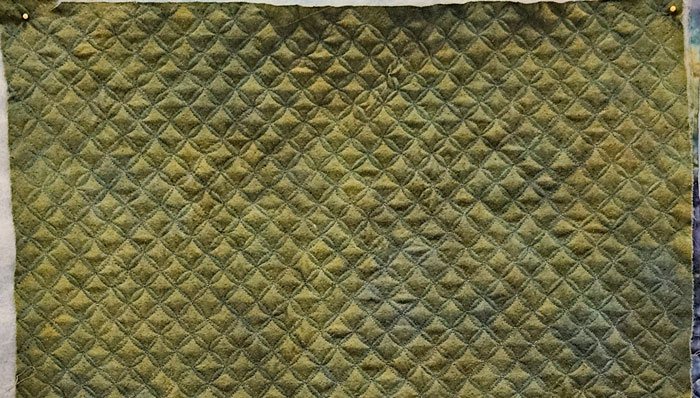
It took me forever to quilt my sleeves, at least 7 hours with marking, re-marking, quilting, and fighting my machine. Diane asks that your sleeve fabric be 29″ x 17″ so that’s a pretty big chunk to quilt times two.
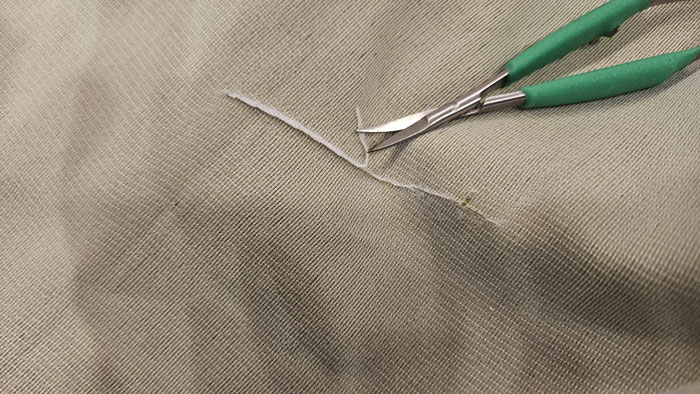
With the exception of the sleeve silk, all the other silks had to be stabilized as they are way too squishy and fidgety otherwise. I don’t like the new Palmer-Pletsch fusible interfacing that I ordered. I should have ordered the “woven fusible” which is a dream to work with. But I stuck with their regular very light weight fusible which stabilizes and barely affects the drape of the silk.
BUT, it is easy to get these little tucks. They will show on the front with these silks, so I used my curved snips to grab that tuck right at the surface of the fabric. If you don’t have snips like this, you need them. There are so many situations where you need to snip right at the surface and no straight snips can do that.
Then I had another problem, now that my fabric was prepared: quilting.
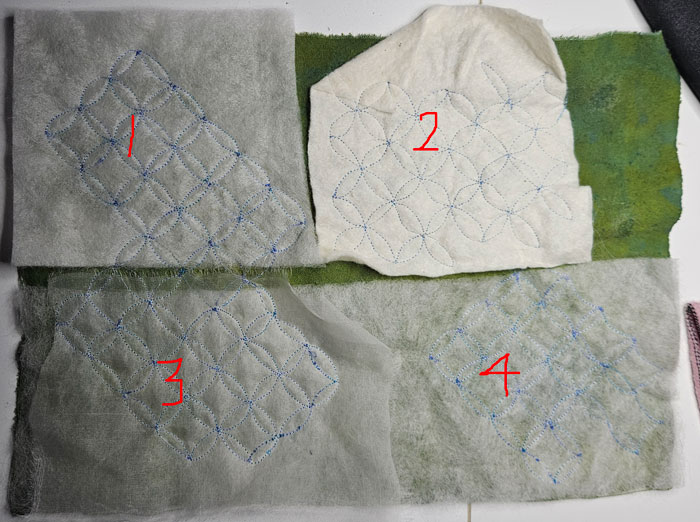
I did NOT want a quilted coat that had the heft of a quilt! I wanted it to have some drape. I had to do some research on the right batting for this project. Cotton batting is a bit problematic since it is stiff. Wool drapes beautifully but has puff which can add pounds to my look. So I tested all of the above:
1. full layer of wool batting
2. thinnest 100% cotton batting
3. half layer of wool batting with a layer of silk organza on top
4. half layer of wool batting.
The cotton was too stiff, the full wool too puffy. The half layer of wool was perfect except that naked batting would be next to my feed dogs and I wasn’t going there. The layer of silk organza added a sheer cover which allowed me to be able to successfully quilt.
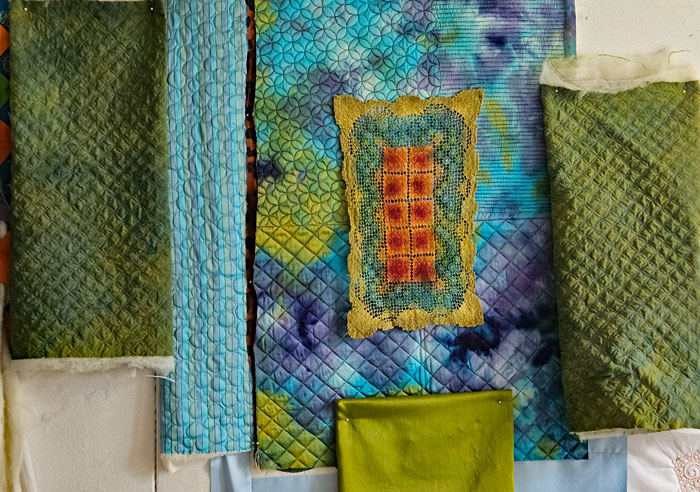
Look at that! This is my assembled bits and pieces which I hope will make a fabulous coat. The silk on the bottom will become my front and needs to be quilted. I forgot to show the proposed pocket material, but I can wait on that.
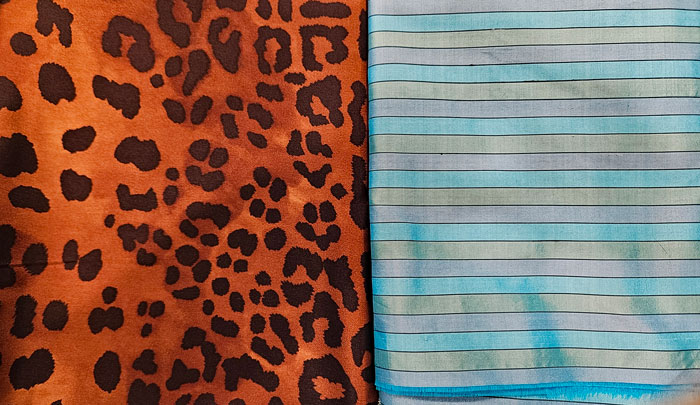
The luscious charmeuse on the left will be my lining. There will be a lot of binding and I will decide whether to use the charmeuse or cut the stripe on the right on the bias for binding. I can decide on that as I go.
Am I not skilled at taking the simple and making it complex??? Geez.
One more thing, I acquired a new piece of art for my home and I’m just tickled!
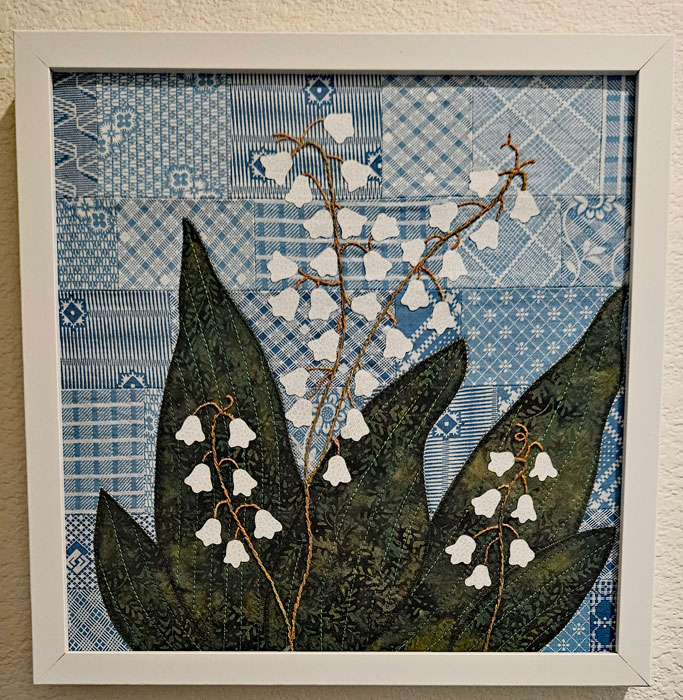
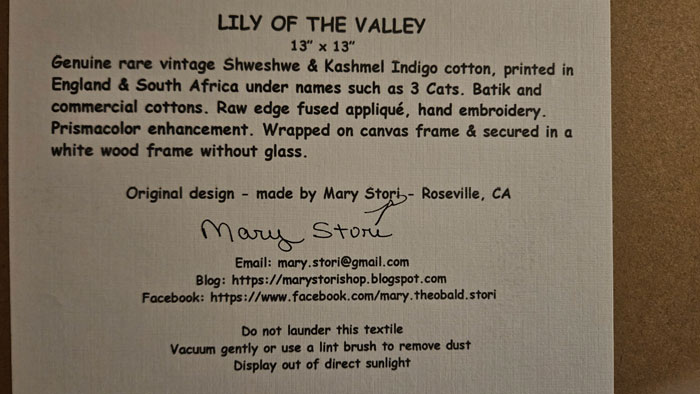
This is by Mary Stori; the colors do not show well but it is divine, all the details meticulously well done. Lily-of-the-valley is a theme that runs through my life so this piece is very special to me. I am thrilled to have this piece in my home!
I’ll be linking up:
Nina-Marie’s Off the Wall Friday

You are fabulous in all of your complexities! If it’s not too late, I have a couple other batting suggestions for your coat. My first choice for a quilt coat/jacket with beautiful drape would be Quilter’s Dream Bamboo, which is really a blend of silk, bamboo, cotton, and Tencel (rayon). It’s somewhere between midweight and lightweight and the drape is absolutely luxurious. If you wanted something warmer with less loft than full wool, I’d try Hobbs Tuscany cotton/wool blend. It’s a lot softer and less stiff than a cotton batting, with a loft similar to an 80/20 or 70/30 cotton/poly blend, but wool fibers instead of poly is better for drape as well as breathability in a garment. I cannot wait to see your coat because I know already that you will obsess over every detail and it will be magnificent! I’m sorry to hear about your main sewbaby going in for service. That is wild that your bobbin case looks so beat up without your realizing it. It looks like a cat was chewing on it!
Thank you! Well the die is cast on my batting choice. I didn’t go through all the batting choices that were never in the running. I love quilters dream bamboo for quilts and yes the drape is glorious. It is unique in that it is both stable and drapey. But it has too much heft for this. I also eliminated anything that had poly, just didn’t want that in a garment. I travel a lot and I just don’t take garments that are bulky or heavy. I also want the garment to breathe and cotton and poly are a bit too much. I have another silk jacket that has full wool batting and it’s just too much. So the half wool batting plus the silk organza , gives me a good combination of low loft but a little bit of puff and the organza keeps it from collapsing yet allows it to drape. I hope this all works because I have invested a lot of time so far already!
The start of your coat looks fabulous, Jenny! How do you cut wool batting to make it thinner? That sounds like a tricky thing to do.
Well thank you! I tease the wool apart in two. It is not an exacting process and the wool is not distributed totally evenly. It’s not tricky, but not exacting.
Looks fabulous, Jenny! I love the petite quilting you did for the sleeves. I, too, was waiting for you to say you tested QDB Bamboo. And what a pretty little piece made by Mary Stori! I love lily of the valley, which is just about to bloom on the north side of my home. Those tiny flowers!!!
Thank you Nancy! Those sleeves took waaaay longer than I thought! I love the QDB, just not for a garment. Mary’s piece stole my heart!
Jenny, I am so grateful you shared your woes and so sorry for all the issues you are trouble shooting. It is reassuring to know that even a master quilter like you, who knows machines inside out, can have struggles from time to time. I am confident you will model your up cycled quilted coat and no one will see the journey it took you on. Who knows, it might even provide you with a new lecture.
Oh thank you Gwyned! Obviously I don’t know that much about machines given the abuse I put my machine through! Yes, the coat has taken on a life of its own. Now my hopes may be too high and a construction issue may cause problems.